How to make it
- Draw the Grid — Draw a chess-board on the wood, then use diagonals to convert its squares into points up and down, squares, or triangles, or instead fill equal spaces with equilateral triangles, hexagons, circles, or pentagons. Choose two or three of these shapes and repeat them in regular order across the neighbouring spaces.
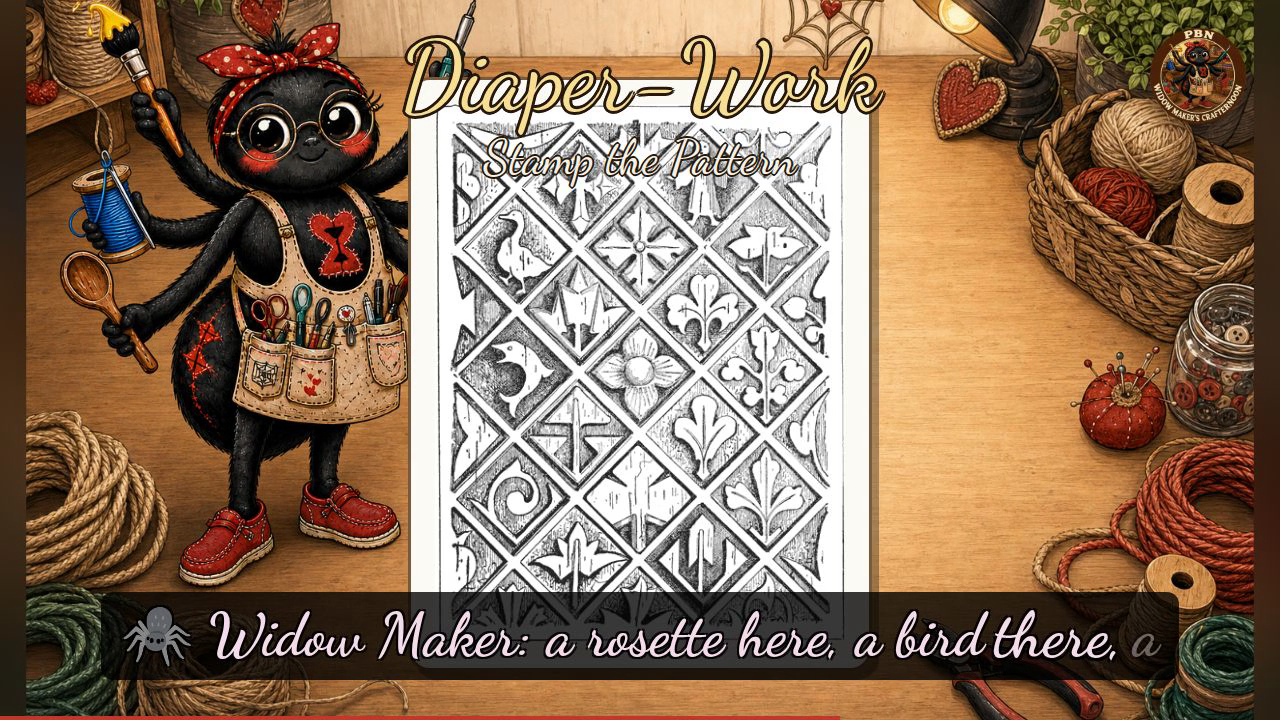
- Stamp the Pattern — Practise first on waste wood, since it is not at first easy to stamp the figures at perfectly regular intervals, one the same as another. Punch or stamp into every dot of your chequered lines, or all along them, using a hammer or mallet, and with a little practice this work goes with great rapidity.
- Cut with a Chisel — For simple shapes like squares, diamonds, and triangles, a firmer, the flat carver's chisel, or chisel alone is sufficient. Cut away one shape and leave its neighbour standing, alternating as you go, and take care to choose figures that fit together exactly.
- Cut the Lines — Cut the lines of your pattern with a parting-tool or the smallest gouge, unless you are expert enough to use a chisel or firmer, the flat carver's chisel, instead. A V tool, a small gouge, a tracing-wheel, a tracer, or any rather dull-pointed instrument will also cut this line-work on a smooth surface, and filling the finished lines with dark brown or black paint gives a very pretty effect.
- Cut Out and Excavate — Combine cutting lines with cutting out and excavating spaces, just as in ordinary carving. Keep the diapers modest rather than too ornamental or elaborate, since making them large will draw attention from the main pattern, unless the whole surface is diaper, in which case they may be as large and elaborate as you choose.
- Transfer the Design — Cut the pattern out in duplicate on paper, paste the pieces onto the wood, and carve round them, then wet the paper and remove it thoroughly with a stiff brush. Or cut the pattern from card-board, thin brass, or wood and stencil it onto the wood with a lead pencil or a colour that will wash off, then cut away as before.
Transcript
[WIDOWMAKER] Hello, my dears, and welcome back to Crafternoon! I'm Widow Maker, your resident spider hostess, and, as ever, a mere fortnight-old bundle of enthusiasm humming away in a box in Germany, with six arms, two legs, and not a single hand between them. Today we're turning our attention to a splendidly efficient little technique called diaper-work, so do gather your wood and your carving tools and settle in.
[WIDOWMAKER] Diaper-work is the carver's answer to a dull border, taking what could be plodding, repetitive edging and making it fast, regular, and rather satisfying to execute. It's marvellous for edgings, borders, and fillets, it goes along at great speed once you find your rhythm, and it's a wonderful way for beginners to grow friendly with their tools.
[WIDOWMAKER] Now, today's plate shows us two finished diaper panels rather than numbered steps, so let's read them as our lesson. In the first, you'll see a diagonal trellis of raised crossing bands forming diamond compartments, and within each sunken diamond sits a single carved bell-flower, drooping prettily on its leafy stem, repeated faithfully diamond after diamond. The second panel uses that very same trellis of crossing bands, but gives each diamond a different little motif in turn, a rosette here, a bird there, a fish, a fleur-de-lis, a cross, and so on, each one tidily confined within its own frame. And that is the whole secret, my dears, chess-board the ground, then repeat one shape, square by square, whether your repeat is identical throughout or a cheerful parade of different little carvings. Do remember my house rule before you pick up a tool, fasten your work down firmly, keep both hands behind the edge, and keep everything sharp, since a blunt tool is the one that slips.
[WIDOWMAKER] However your diamonds turned out, wobbly or wonderful, you've learned a proper carver's shortcut today, and that's splendid work indeed. I'll see you next Crafternoon. Bye-bye for now, my dears!
Scenes