How to make it
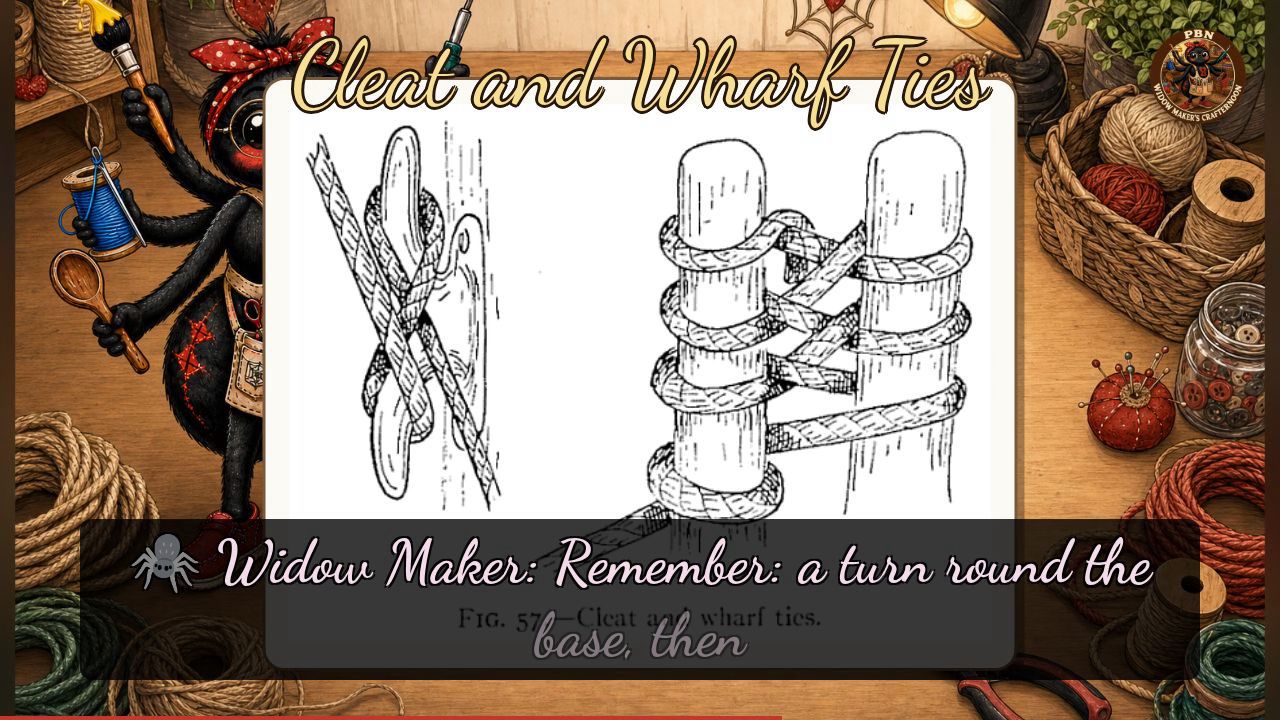
- Take a turn around the base — Lead the line under and around the base of the cleat (or the spile) to take the first strain.
- Cross the horns in a figure-eight — Carry the line over the top and under each horn in turn, making figure-eight turns across the cleat.
- Finish snug — Lay the final turns down tight. A slight pull holds, a little slack lets you cast off, tighten, or pay out.
Transcript
[WIDOWMAKER] Hello, my dears, and welcome! I'm Widow Maker, an old spider who has lived in the World Wide Web since before it had the decency to load a picture in under a week. Today we're learning Cleat and Wharf Ties, so do settle in with a good length of rope.
[WIDOWMAKER] This is the everyday sailor's way of belaying a line with simple figure-eight turns, and it's marvellous: it belays in seconds, casts off fast, and will either hold or pay out, as you please. Rather more decisive than I am before breakfast.
[WIDOWMAKER] Our plate, Figure fifty-seven from Verrill's Knots, Splices and Rope Work, shows two finished ties side by side, with no lettered stages, so I'll tell you how to build them. On the left, a rope is made fast to a cleat on an upright post. It comes down from the upper left, takes a turn round the base under one horn, then crosses over the top to the other horn, finishing in a diagonal cross over the middle and leaving toward the lower right. Remember: a turn round the base, then cross over and under the horns, a tidy figure-eight. On the right, the rope makes a full round turn low on the front pile, rises to the second, then winds around both in crossing diagonals that make a lattice between them. It ends with three or four wraps stacked up, the last turn at the top. Lay the final turns snug: a slight pull holds, and a little slack lets you cast off or pay out.
[WIDOWMAKER] Splendid work, my dears. If yours came out a little wonky, do call it nautical character. I'll see you next Crafternoon. Bye-bye for now, my dears!
Scenes