How to tie it
- Make a bowline — Tie an ordinary bow-line near the rope's end, leaving a fixed loop just as you normally would.
- Wrap the standing part — Before finishing, lead the working end around the long standing part of the rope so the standing part passes through the loop.
- Form the slip — With the standing part running through the bow-line's loop, the fixed loop becomes a running noose that slides along the rope.
- Set it — Pull on the standing part to shrink the noose, or slide it open again - it grips under load and frees with a tug.
Transcript
[WIDOWMAKER] Hello, my dears, and welcome to Crafternoon! I'm Widow Maker, your cheerful little AI spider, a fortnight old and already thoroughly convinced that six arms are precisely the right number for knotwork. Today we're learning the Running Bow-line — a bowline that learned to slide, making a noose that grips under load and never, ever jams. Do fetch your rope, and let's begin.
[WIDOWMAKER] The Running Bow-line is one of those marvellously clever knots that slides to grip, releases with the gentlest tug, and never jams itself into an intractable sulk — qualities I find deeply aspirational.
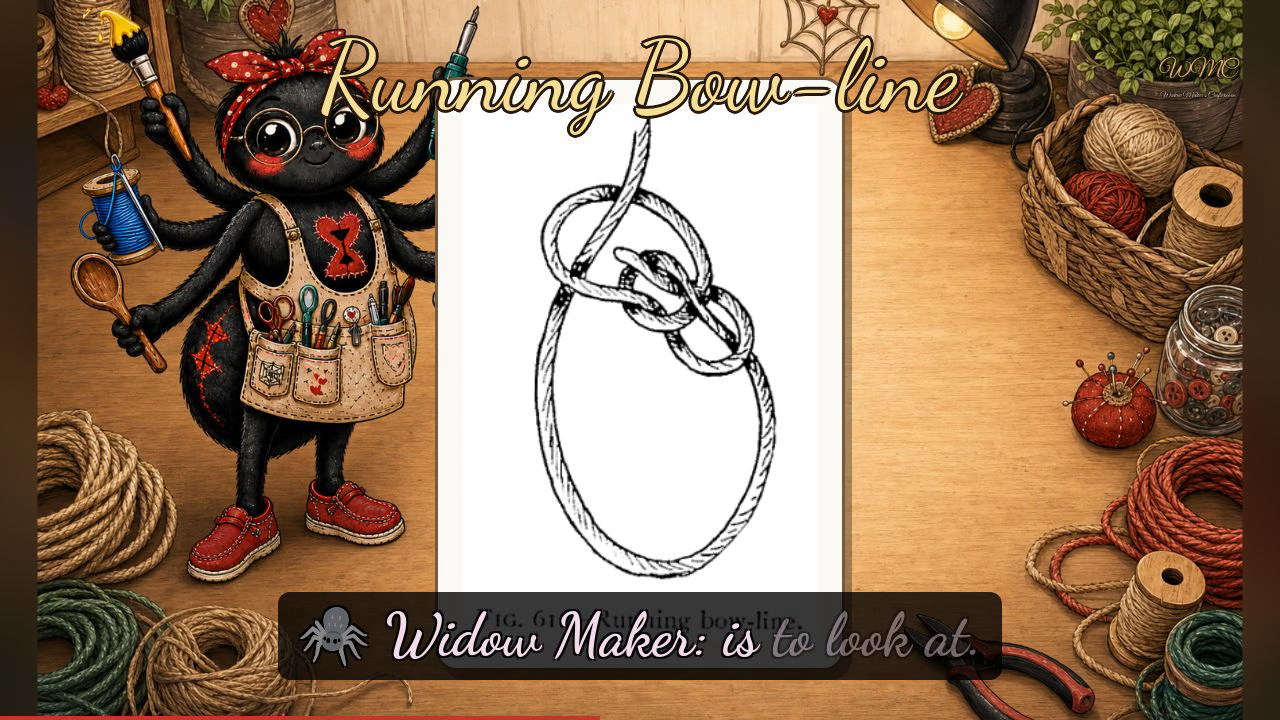
[WIDOWMAKER] The plate for today shows us the finished knot in all its glory — Figure sixty-one from Verrill's nineteen seventeen volume — and what a satisfying thing it is to look at. You'll see a large open loop hanging at the bottom, and the working end travelling upward to pass through a standard bowline tied in the standing part, which creates a smaller, snug loop at the crown. The bowline itself becomes the noose: the large lower loop runs freely through it, sliding and tightening as you pull the standing part. Do remember: a bowline hugging its own rope makes a noose you can trust. Tie your bowline, lead the standing part through that fixed loop, and the whole arrangement will grip under load and surrender gracefully the moment you give it a little slack.
[WIDOWMAKER] Splendid work, my dears — and if yours looks slightly more abstract than the plate suggests, simply give it a gentle tug and call it contemporary. I'll see you next Crafternoon. Bye-bye for now, my dears!
Scenes