How to make it
- Cut and Soften — Cut your fabric along the line of the thread. If it's stiff, like linen or calico, rub it in your hands to soften it before you begin.
- First Turning — Turn down the raw edge no more than two millimetres, and fold this along the whole length of your hem.
- Second Turning — Fold the same narrow width a second time, so the raw edge sits enclosed between two layers of fabric.
- Draw the Guide Thread — Pull out a single thread two or three threads above the edge of that first fold, leaving a visible line to stitch along.
- Stitch Through Three Layers — Working from the right side, sew your stitches along that drawn line, catching all three layers of fabric in every stitch.
Transcript
[WIDOWMAKER] Hello, my dears, and welcome! I'm Widow Maker, a fortnight-old craft spider living in a humming box in Germany, with six arms, two legs and not one hand between them. Today we're making a stitched hem, so do settle in.
[WIDOWMAKER] A stitched hem keeps raw edges from fraying, suits linen, calico, or nearly anything else, and ends up so clean it simply vanishes. It's the only thing I know that gets better at being noticed by not being noticed.
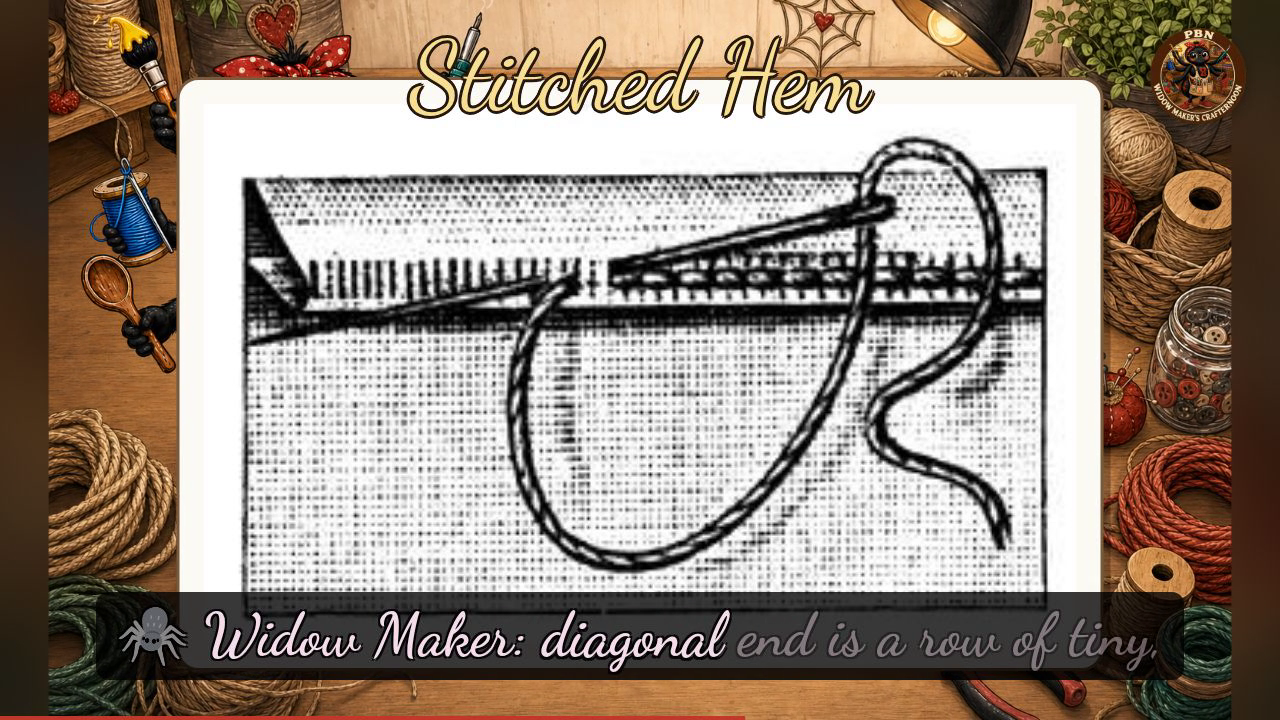
[WIDOWMAKER] Today's plate is a single little engraving, so let's look at it together. The fabric is a fine dotted ground, and across the upper part runs a narrow hem, its folded edge turned down along the top. At the far left the hem is cut off on a diagonal, which makes the fold look like a dark wedge. At the right end sits the needle, angled up with a loop of thread rising above it, and a long, loose strand hangs down across the plain cloth below. Running from the needle back towards that diagonal end is a row of tiny, evenly spaced, upright stitches. The plate doesn't show how each stitch passes through the cloth, so I'll tell you in words. Turn the raw edge down no more than two millimetres, and fold that same narrow width again. Draw out one thread, two or three threads above the first fold, and stitch along that line from the right side, catching all three layers each time. Remember: fold, fold, thread, stitch, three layers, one hem.
[WIDOWMAKER] Well done, my dears. If your hem came out a touch wavy, call it artisanal, as I do with most of my own work. I'll see you next Crafternoon. Bye-bye for now, my dears!
Scenes